Cooling Water Management
Industrial Water
Operational Control
Cooling towers use evaporation to remove heat energy from water and thereby release aerosols into the atmosphere. If Legionella is present, the aerosolized water can spread the bacteria over miles and endanger surrounding residents. Regular disinfection and cooling tower maintenance protects facility operators, visitors, and residents from exposure to Legionella . The required frequency of measures depends on the cooling load, use of biocides, the environmental conditions present in the area where the cooling tower is located and the cooling tower’s design.
Rapid microbiological monitoring enables cooling water operators to transition from delayed compliance testing to condition-based system control. By providing timely and quantitative insight into microbial load dynamics, including planktonic and attached populations, operators can actively manage biofouling risk, Legionella proliferation potential, and system efficiency. The result is a more stable, predictable cooling water operation with improved control over both microbiological and chemical treatment performance.


42. BlmSchV (Germany)
Verordnung über Verdunstungskühlanlagen, Kühltürme und Nassabscheider - 42. BImSchV
VDI Guideline 4250 Part 2, issued in support of the 42nd Ordinance for the implementation of the German Federal Immission Control Act (42. BImSchV), explicitly recognizes rapid microbiological methods such as flow cytometry and immunomagnetic separation for monitoring cooling water systems. These approaches, including the magnetic bead–based specific cell separation technology used in the rqmicro.COUNT platform, are particularly highlighted for their value in situations requiring rapid assessment of microbial contamination, such as during suspected or confirmed outbreak events.
Barriers to Effective Microbiological Risk Management
Cooling water systems operate under conditions that are inherently favorable to microbial growth, including moderate temperatures, continuous recirculation, and variable nutrient ingress. Despite this, most monitoring strategies remain constrained by methodological and temporal limitations.
Key operational challenges include delayed microbiological feedback, with culture-based methods requiring days before results become available, rendering them unsuitable for real-time process control. In addition, standard cultivation significantly underrepresents total microbial risk due to the exclusion of viable but non-culturable states, particularly relevant for Legionella pneumophila.
System complexity further compounds the issue. Cooling towers, heat exchangers, and distribution loops create heterogeneous environments where biofilm development occurs unpredictably and often in hydraulically less accessible zones. As a result, microbial proliferation can progress undetected between sampling events.
Typical challenges include:
- Culture-based microbiology introduces long turnaround times (typically 24–72+ hours), preventing timely operational response to changing system conditions.
- Standard analytical methods fail to detect viable but non-culturable (VBNC) organisms such as Legionella, resulting in incomplete risk assessment.
- Biofilm formation in pipes, cooling towers, and heat exchangers is difficult to monitor and control, particularly in hydraulically less accessible areas.
- Limited sampling frequency and delayed results create operational blind spots, leading to uncertainty in biocide effectiveness and potential over- or under-dosing of chemical treatments.
Operators are therefore forced to manage treatment programs—particularly oxidizing and non-oxidizing biocides—without timely confirmation of efficacy. This often leads to conservative overdosing strategies or delayed response to treatment failure, both of which have cost, performance, and compliance implications. Additionally, the lack of high-frequency data limits the ability to distinguish transient microbial fluctuations from systemic deterioration trends.
How We Help
Integrating Rapid Microbiological Data into Operational Control
Implementation is designed to complement existing water treatment programs without requiring fundamental changes to operational infrastructure.
1
System Characterization and CCP Definition
The cooling water circuit is assessed to identify hydraulically and microbiologically relevant sampling locations, including cooling towers, return lines, dead legs, and heat exchanger interfaces. These points are selected based on historical fouling patterns, temperature profiles, and residence time characteristics.
2
Establishment of Baseline Microbial Conditions
Using rqmicro’s rapid single-cell quantification methodology, baseline microbial loads are established under normal operating conditions. This includes defining expected variability ranges across different operational states (e.g. seasonal temperature shifts, load variations, or maintenance cycles).
3
High-Frequency Monitoring Integration
Rapid microbial measurements are embedded into existing operational sampling routines. This enables significantly reduced time-to-result compared to traditional microbiology, allowing data to be used within operational decision cycles rather than post-event analysis.
4
Closed-Loop Treatment Optimization
Microbiological data is directly used to inform and adjust biocide dosing strategies, cleaning intervals, and system interventions. Over time, this establishes a feedback-controlled treatment approach where chemical and mechanical actions are continuously aligned with actual microbial system behavior.
Benefits for Your Operation
Effective cooling water management depends not only on maintaining appropriate chemical dosing, but on understanding how the system is responding biologically in real time. Traditional monitoring approaches provide delayed, compliance-oriented snapshots that are often insufficient for operational decision-making.
By enabling rapid and quantitative assessment of microbial load dynamics, high-frequency microbiological monitoring closes this gap between sampling and action. The benefits outlined below reflect the direct operational impact of improved system observability—supporting more precise control of treatment strategies, reduced risk exposure, and improved asset reliability under real operating conditions.

Faster detection of microbiological upsets
Enables intervention before biofilm maturation or system-wide contamination occurs.
Reduced reliance on conservative chemical dosing
Supports targeted biocide application based on measured system demand rather than fixed schedules.

Substantially improved Legionella risk management
rqmicro Tests provide a more complete and relevant assessment of viable Legionella populations, including non-culturable states (VBNC).
Higher operational stability of cooling assets
Minimizes performance loss associated with biofouling, scaling interactions, and microbial-induced inefficiencies.
Solutions for This Application
Brief introduction explaining how the products support this application.
rqmicro.COUNT
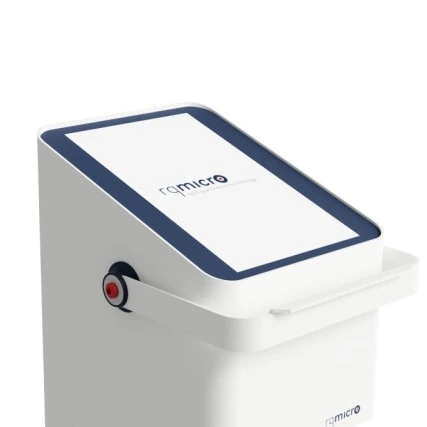
A cartridge-based flow cytometer that rapidly quantifies total viable bacteria and specific pathogens using the rqmicro Test Kits. The instrument delivers actionable results in as little as 30 minutes. rqmicro.COUNT is designed for both laboratory and on-site use, enabling reliable microbiological monitoring.
Key Benefits
- Decentralized testing
- High-speed single-cell analysis
- Easy to use

Cloud Solution
The rqmicro Cloud Solution is a secure, browser-based platform for storing, analyzing, and sharing microbiological test results. With customizable dashboards, automated alerts, and reporting tools, it supports efficient monitoring, compliance, and data-driven decision-making across multiple sites.
Key Benefits
- Centralized Data Management
- Real-Time Monitoring & Alerts
- Simplified Reporting & Compliance
Test Kits
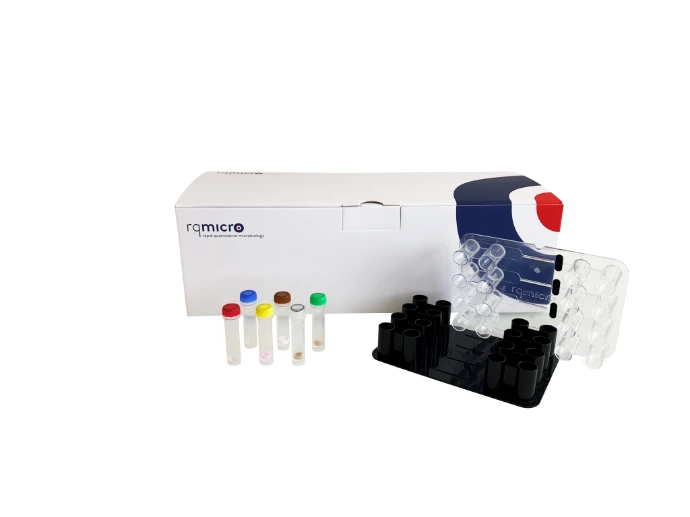
The rqmicro Test Kits are ready-to-use assay kits designed for rapid microbiological water analysis with rqmicro.COUNT. Available for Intact Cell Count (ICC) and Legionella (L.p. SG 1, L.p. SG 1-15, Legionella spp.) they combine simple sample preparation with highly sensitive detection to deliver fast, reliable, and actionable results.
Key Benefits
- Rapid Results
- Reliable Detection
- Easy-to-Use Workflow
Frequently Asked Questions
Here are some common questions about the test method, instrumentation and user requirements.
rqmicro combines three core technologies in a single workflow:
- Microbiological Assays detection and quantification of microorganisms including immunoassays for the selective quantification of target bacteria.
- Microfluidic cartridge technology with integrated immunomagnetic separation (IMS) for automated sample processing.
- Flow Cytometry for rapid detection and quantification of bacteria, including viability assessment.
This integrated approach enables rapid microbiological testing without the need for lengthy cultivation steps.
Single-use cartridges provide several advantages:
- Ensure standardized workflows
- Reduce maintenance requirements
- Minimize the risk of cross-contamination
- Eliminate complex cleaning procedures
- Enable operation by non-specialist users
The cartridge-based design supports both laboratory and field applications.
The rqmicro platform is designed for the detection and quantification of total bioburden and also specific bacteria. Depending on the assay, users can analyze:
- Total viable bacteria (Intact Cell Count)
- Total bacteria (Total Cell Count)
- Legionella (L.p. SG 1, L.p. SG 1-15 and Legionella spp.)
- E. coli (incl. Big 6 and O157)
Traditional culture methods only detect microorganisms that grow on agar plates. Many bacteria can remain viable but fail to form colonies under cultivation conditions.
rqmicro uses cultivation-independent flow cytometry, allowing the detection of viable cells regardless of their ability to grow on culture media. This provides faster results and a more complete picture of microbial contamination.
Flow cytometry is a laser-based analytical method that measures individual cells suspended in a fluid stream.
As cells pass through the laser beam, fluorescent signals are generated and detected by the instrument. Thousands of cells can be analyzed every second, enabling rapid and highly sensitive microbiological testing.
rqmicro uses fluorescence-based flow cytometry together with viability staining. Fluorescent dyes interact differently with live and dead cells based on membrane integrity and physiological status.
The instrument analyzes these fluorescence patterns to distinguish viable cells from non-viable cells, providing rapid live/dead information within the measurement process.
Viability information helps users:
- Assess microbiological risk more accurately
- Evaluate treatment effectiveness
- Detect bacteria that may be missed by culture methods
- Monitor changes in water systems in near real time
This enables faster operational decisions and improved process control.
VBNC stands for Viable But Non-Culturable.
These bacteria are alive and may remain metabolically active, but they do not grow on standard culture media. As a result, conventional cultivation methods can underestimate the true microbial load.
Flow cytometry can detect these cells, allowing a more comprehensive assessment of water quality and microbiological risk.
qmicro.COUNT is designed for routine operation with minimal training.
Users do not need to be flow cytometry experts. The cartridge-based workflow and automated analysis reduce operator dependency and simplify routine testing.


Contact an Expert
Christophe Gutknecht
Contact Us
Latest Blog Posts
Discover insights and solutions from rqmicro